Antarctic Countries
The Antarctic region encompasses 5 countries with a combined population of 2K, making it one of the least populous regions on Earth. Antarctica (1K) is the region's most populous nation, accounting for a significant share of the regional total. 5 countries have no land borders, functioning as island or maritime states. 0 of 5 countries are United Nations members, participating in the full range of multilateral institutions.
Countries
5
Total Population
2K
Most Populous
Antarctica
1K
Largest by Area
Antarctica
14,000,000 km²
Population Breakdown
Antarctic's population of 2K is heavily concentrated in a small number of nations. The five most populous countries are Antarctica (1K), French Southern and Antarctic Lands (400), Heard Island and McDonald Islands (0), South Georgia (0), Bouvet Island (0). These top 5 nations account for 100% of Antarctic's total population, illustrating the uneven distribution of people across the region. Linguistically, Antarctic is home to approximately 3 distinct languages across its 5 nations, reflecting considerable cultural and ethnic diversity. At the other end of the spectrum, the three least populous nations are Bouvet Island (0), South Georgia (0), Heard Island and McDonald Islands (0). The least populous nation, Bouvet Island, has 0 people, representing a fraction of a percent of the region's total.
Geographic Profile
The region covers a combined land area of 14,012,111 km². Antarctica is the largest country at 14,000,000 km², while Antarctica is the smallest at 14,000,000 km². The geographic extent of Antarctic spans 10 distinct timezones, reflecting a substantial east-west range. 5 nations function as island or maritime states with no land borders, relying entirely on sea and air links for international connectivity. The varied terrain across Antarctic includes a wide range of climatic zones and ecological systems, from tropical rainforests to arid deserts and high-altitude mountain ranges, shaping both settlement patterns and economic activity throughout the region.
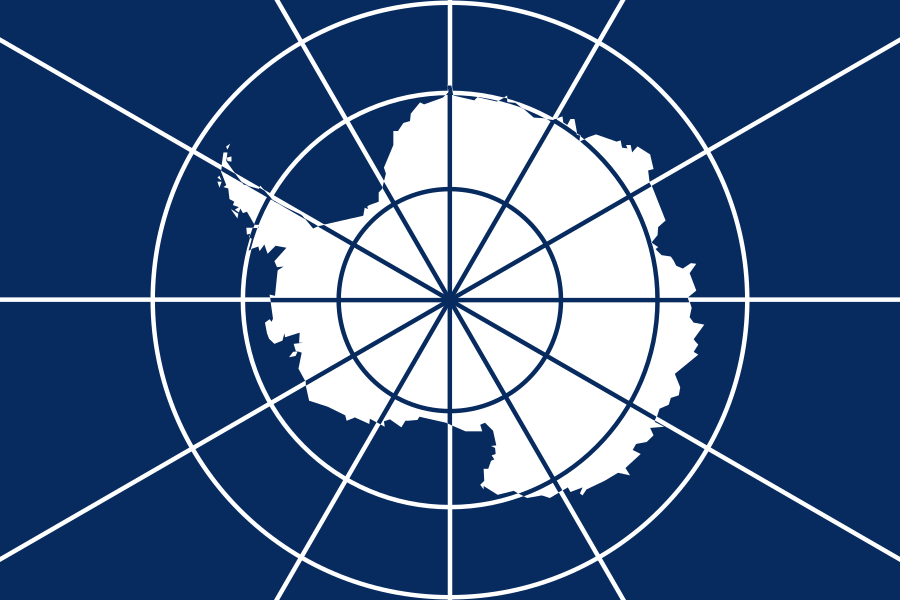 Antarctica
- Population
- 1K
- Capital
- —
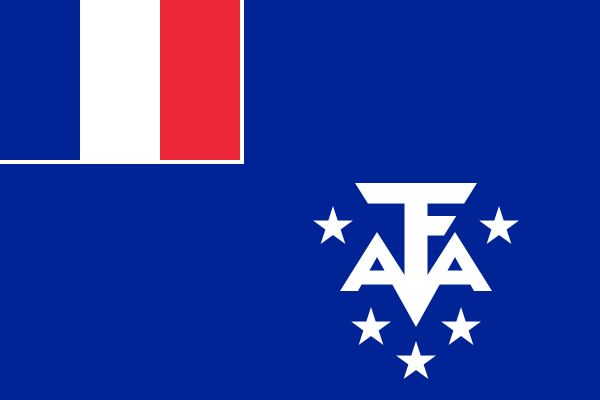 French Southern and Antarctic Lands
- Population
- 400
- Capital
- Port-aux-Français
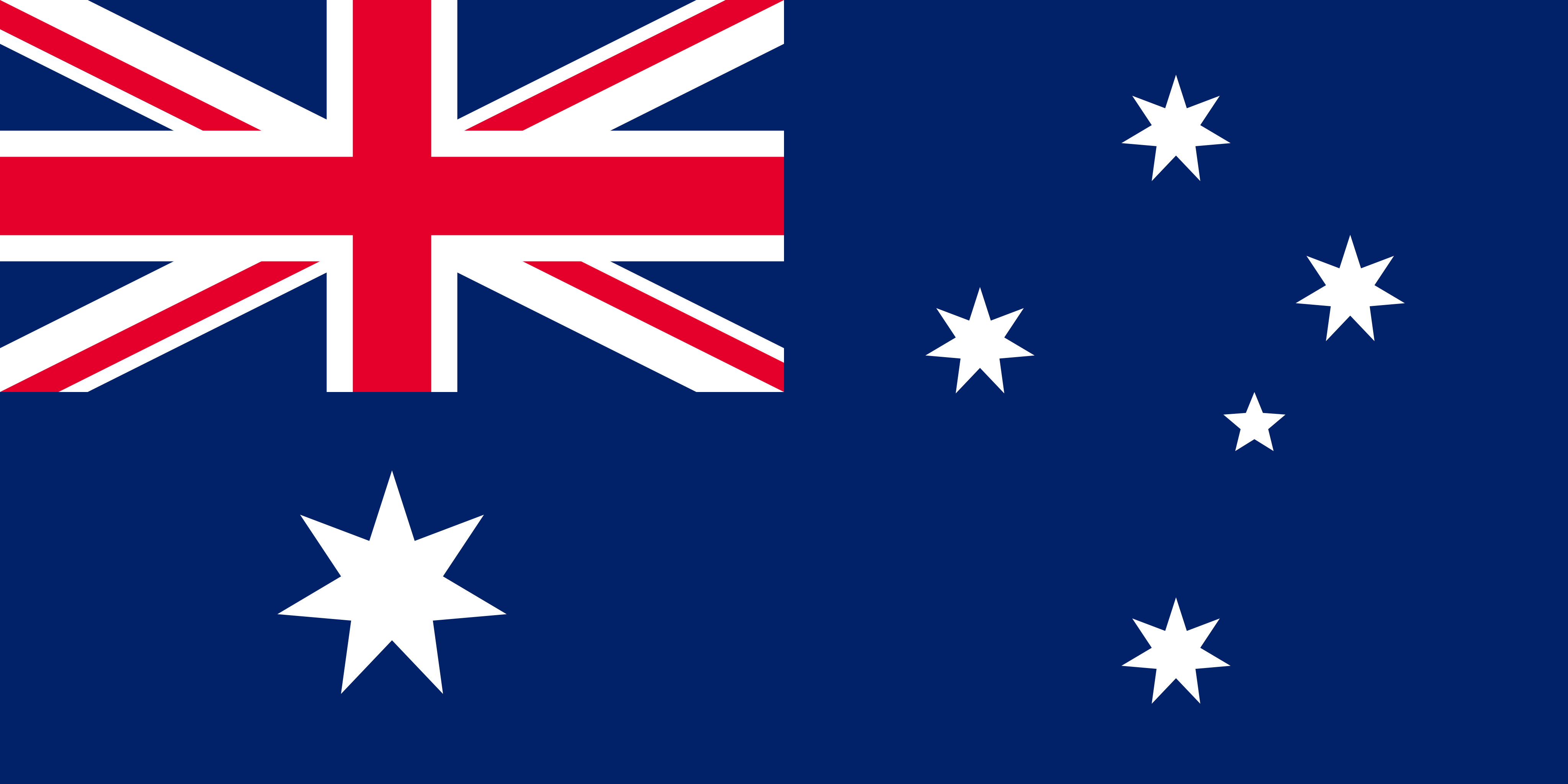 Heard Island and McDonald Islands
- Population
- 0
- Capital
- —
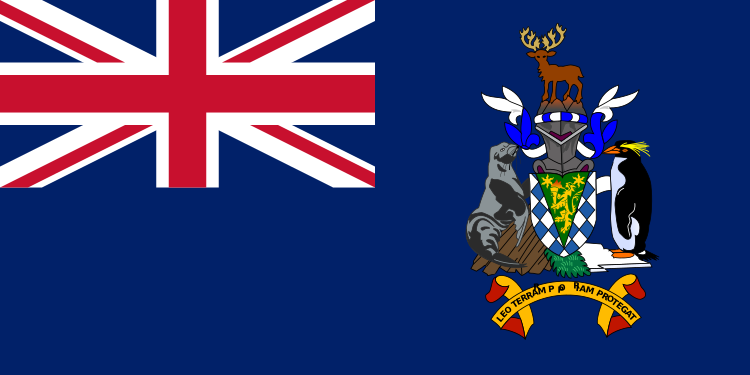 South Georgia
- Population
- 0
- Capital
- King Edward Point
 Bouvet Island
- Population
- 0
- Capital
- —
Economic Profile
The region spans 1 subregion with 2 distinct currencies, 0 independent nations, and 5 dependent territories. Economic activity is distributed across the region's independent nations. Economic development across Antarctic varies considerably by subregion, with some areas classified as high-income by the World Bank and others as lower-middle-income. The presence of 2 distinct currencies reflects the monetary policy diversity across the region, ranging from independently floating exchange rate regimes to currency unions and dollarized economies. Trade integration varies significantly among the region's 0 sovereign states.
Country Highlights
Antarctic contains countries that represent the full spectrum of population size, land area, and geographic connectivity. Antarctica is the most populous nation with 1K residents with a population density of 0 people per km². At the other extreme, Bouvet Island is the least populous with 0 people. By land area, Antarctica is the largest at 14,000,000 km², giving it a vast geographic footprint within the region. Antarctica is the smallest at 14,000,000 km², making it one of the more compact nations in Antarctic. In terms of land connectivity, Antarctica shares land borders with 0 countries, the most in the region. This extensive border network reflects its central geographic position and influences its trade, migration, and diplomatic relationships with neighboring states.
Historical Context
Antarctica is the world's southernmost continent covering approximately 14 million km², making it the fifth-largest continent. It has no permanent human population and no sovereign nations. The Antarctic Treaty System, signed in 1959, governs the continent and is now ratified by 56 nations. Scientific research stations from over 30 countries operate on the continent. Antarctica contains approximately 70% of the world's fresh water in the form of ice. No commercial exploitation or military activity is permitted under the Treaty.
Frequently Asked Questions
How many countries are in Antarctic?
Antarctic has 5 countries. Of these, 0 are United Nations member states and 0 are recognized as fully independent nations. 5 countries have no land borders and operate as island or maritime states.
What is the total population of Antarctic?
The total population of Antarctic is approximately 2K (World Bank data). Antarctica is the most populous country in the region with 1K residents. The least populous nation, Bouvet Island, has 0 people.
What is the largest country in Antarctic?
Antarctica is the largest country in Antarctic by land area, covering 14,000,000 km². This makes it the dominant geographic presence in the region. The second-largest is French Southern and Antarctic Lands at 7,747 km².
What is the smallest country in Antarctic?
Antarctica is the smallest country in Antarctic by land area, covering just 14,000,000 km². Despite its small size, it is a fully recognized nation.
What languages are spoken in Antarctic?
Antarctic is home to approximately 3 distinct languages across its 5 nations. The most widely spoken languages in the region include English, French, Norwegian. This linguistic diversity reflects the varied ethnic and cultural heritage of Antarctic's peoples, shaped by both indigenous traditions and historical patterns of migration and colonization.