Europe Countries
The Europe region encompasses 53 countries with a combined population of 741.7M, making it a significant regional population bloc. Russia (146.0M) is the region's most populous nation, accounting for a significant share of the regional total. 9 countries have no land borders, functioning as island or maritime states. 44 of 53 countries are United Nations members, participating in the full range of multilateral institutions.
Countries
53
Total Population
741.7M
Most Populous
Russia
146.0M
Largest by Area
Russia
17,098,246 km²
Population Breakdown
Europe's population of 741.7M is heavily concentrated in a small number of nations. The five most populous countries are Russia (146.0M), Germany (83.5M), United Kingdom (69.3M), France (66.4M), Italy (58.9M). These top 5 nations account for 57% of Europe's total population, illustrating the uneven distribution of people across the region. Linguistically, Europe is home to approximately 49 distinct languages across its 53 nations, reflecting considerable cultural and ethnic diversity. At the other end of the spectrum, the three least populous nations are Vatican City (882), Svalbard and Jan Mayen (3K), Åland Islands (31K). The least populous nation, Vatican City, has 882 people, representing a fraction of a percent of the region's total.
Geographic Profile
The region covers a combined land area of 23,129,737.51 km². Russia is the largest country at 17,098,246 km², while Russia is the smallest at 17,098,246 km². The geographic extent of Europe spans 23 distinct timezones, reflecting a substantial east-west range. 9 nations function as island or maritime states with no land borders, relying entirely on sea and air links for international connectivity. The varied terrain across Europe includes a wide range of climatic zones and ecological systems, from tropical rainforests to arid deserts and high-altitude mountain ranges, shaping both settlement patterns and economic activity throughout the region.
 Russia
- Population
- 146.0M
- Capital
- Moscow
 Germany
- Population
- 83.5M
- Capital
- Berlin
 United Kingdom
- Population
- 69.3M
- Capital
- London
 France
- Population
- 66.4M
- Capital
- Paris
 Italy
Italy- Population
- 58.9M
- Capital
- Rome
 Spain
Spain- Population
- 49.3M
- Capital
- Madrid
 Poland
- Population
- 37.4M
- Capital
- Warsaw
 Ukraine
- Population
- 32.9M
- Capital
- Kyiv
 Romania
- Population
- 19.0M
- Capital
- Bucharest
 Netherlands
- Population
- 18.1M
- Capital
- Amsterdam
 Belgium
- Population
- 11.8M
- Capital
- Brussels
 Czechia
- Population
- 10.9M
- Capital
- Prague
 Portugal
- Population
- 10.7M
- Capital
- Lisbon
 Sweden
- Population
- 10.6M
- Capital
- Stockholm
 Greece
- Population
- 10.4M
- Capital
- Athens
 Hungary
- Population
- 9.5M
- Capital
- Budapest
 Austria
- Population
- 9.2M
- Capital
- Vienna
 Belarus
- Population
- 9.1M
- Capital
- Minsk
 Switzerland
- Population
- 9.1M
- Capital
- Bern
 Serbia
- Population
- 6.6M
- Capital
- Belgrade
 Bulgaria
- Population
- 6.4M
- Capital
- Sofia
 Denmark
- Population
- 6.0M
- Capital
- Copenhagen
 Finland
- Population
- 5.7M
- Capital
- Helsinki
 Norway
- Population
- 5.6M
- Capital
- Oslo
 Ireland
- Population
- 5.5M
- Capital
- Dublin
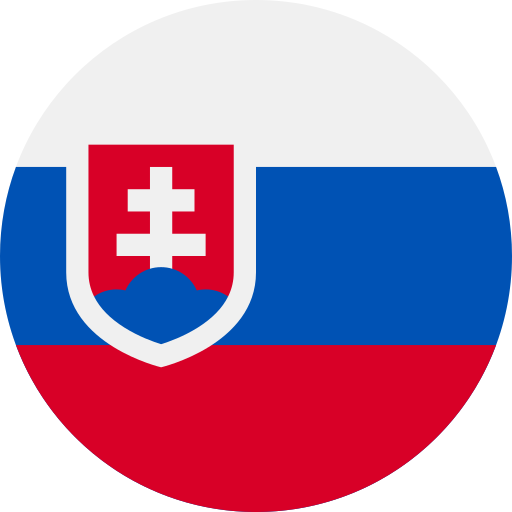 Slovakia
- Population
- 5.4M
- Capital
- Bratislava
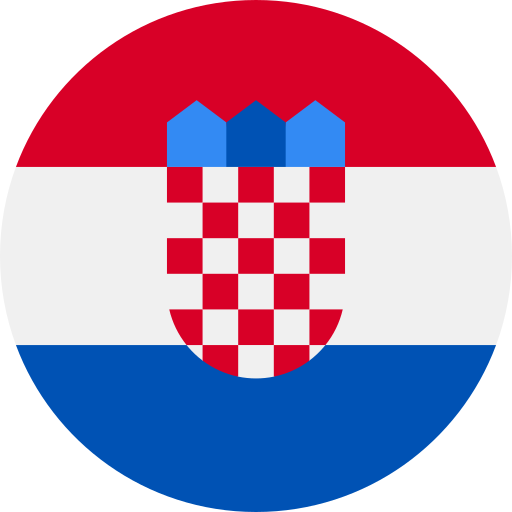 Croatia
- Population
- 3.9M
- Capital
- Zagreb
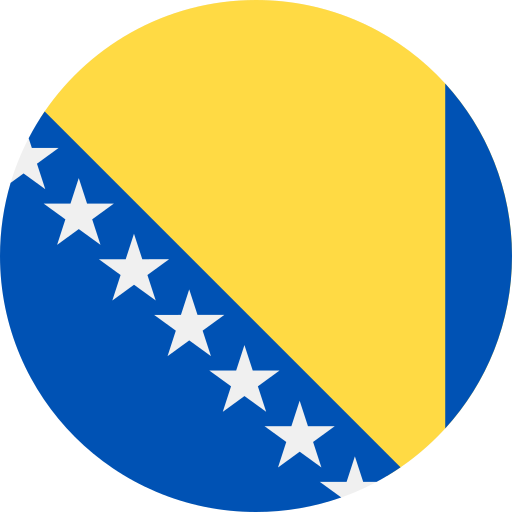 Bosnia and Herzegovina
- Population
- 3.4M
- Capital
- Sarajevo
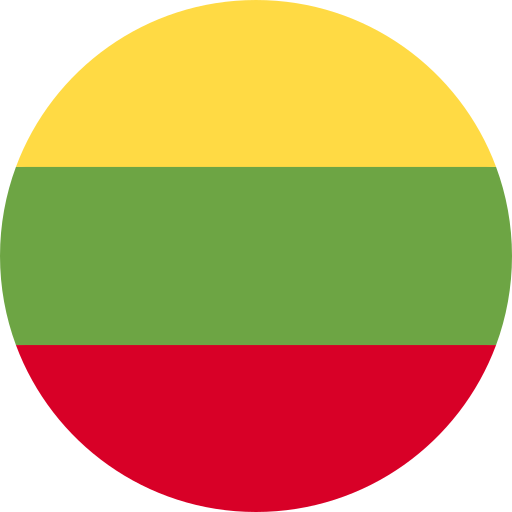 Lithuania
- Population
- 2.9M
- Capital
- Vilnius
 Moldova
- Population
- 2.7M
- Capital
- Chișinău
 Albania
- Population
- 2.4M
- Capital
- Tirana
 Slovenia
- Population
- 2.1M
- Capital
- Ljubljana
 Latvia
- Population
- 1.8M
- Capital
- Riga
 North Macedonia
- Population
- 1.8M
- Capital
- Skopje
 Kosovo
- Population
- 1.6M
- Capital
- Pristina
 Cyprus
- Population
- 1.4M
- Capital
- Nicosia
 Estonia
- Population
- 1.4M
- Capital
- Tallinn
 Luxembourg
- Population
- 682K
- Capital
- Luxembourg
 Montenegro
- Population
- 623K
- Capital
- Podgorica
 Malta
Malta- Population
- 574K
- Capital
- Valletta
 Iceland
- Population
- 392K
- Capital
- Reykjavik
 Jersey
- Population
- 103K
- Capital
- Saint Helier
 Andorra
- Population
- 88K
- Capital
- Andorra la Vella
 Isle of Man
- Population
- 85K
- Capital
- Douglas
 Guernsey
- Population
- 65K
- Capital
- St. Peter Port
 Faroe Islands
- Population
- 55K
- Capital
- Tórshavn
 Liechtenstein
- Population
- 41K
- Capital
- Vaduz
 Monaco
- Population
- 38K
- Capital
- Monaco
 Gibraltar
- Population
- 38K
- Capital
- Gibraltar
 San Marino
- Population
- 34K
- Capital
- City of San Marino
 Åland Islands
- Population
- 31K
- Capital
- Mariehamn
 Svalbard and Jan Mayen
- Population
- 3K
- Capital
- Longyearbyen
 Vatican City
- Population
- 882
- Capital
- Vatican City
Economic Profile
The region spans 6 subregions with 25 distinct currencies, 46 independent nations, and 7 dependent territories. Germany, France, and the United Kingdom are Europe's three largest economies. Economic development across Europe varies considerably by subregion, with some areas classified as high-income by the World Bank and others as lower-middle-income. The presence of 25 distinct currencies reflects the monetary policy diversity across the region, ranging from independently floating exchange rate regimes to currency unions and dollarized economies. Trade integration varies significantly among the region's 46 sovereign states.
Country Highlights
Europe contains countries that represent the full spectrum of population size, land area, and geographic connectivity. Russia is the most populous nation with 146.0M residents with a population density of 9 people per km². At the other extreme, Vatican City is the least populous with 882 people. By land area, Russia is the largest at 17,098,246 km², giving it a vast geographic footprint within the region. Russia is the smallest at 17,098,246 km², making it one of the more compact nations in Europe. In terms of land connectivity, Russia shares land borders with 14 countries, the most in the region. This extensive border network reflects its central geographic position and influences its trade, migration, and diplomatic relationships with neighboring states.
Historical Context
Europe encompasses 44 sovereign nations across an area of approximately 10.5 million km². The European Union, comprising 27 member states, forms the world's largest single market with a combined GDP exceeding $16 trillion. Europe has the highest concentration of high-income economies of any region, with 38 of 44 nations classified as high-income by the World Bank. The continent hosts 3 of the G7 nations (Germany, France, United Kingdom) and 4 of the G20 (including Italy). The Schengen Area allows passport-free travel across 27 countries. NATO provides collective defense for 32 member states.
Frequently Asked Questions
How many countries are in Europe?
Europe has 53 countries. Of these, 44 are United Nations member states and 46 are recognized as fully independent nations. 9 countries have no land borders and operate as island or maritime states.
What is the total population of Europe?
The total population of Europe is approximately 741.7M (World Bank data). Russia is the most populous country in the region with 146.0M residents. The least populous nation, Vatican City, has 882 people.
What is the largest country in Europe?
Russia is the largest country in Europe by land area, covering 17,098,246 km². This makes it the dominant geographic presence in the region. The second-largest is Ukraine at 603,550 km².
What is the smallest country in Europe?
Russia is the smallest country in Europe by land area, covering just 17,098,246 km². Despite its small size, it is a fully independent nation and a United Nations member state.
What languages are spoken in Europe?
Europe is home to approximately 49 distinct languages across its 53 nations. The most widely spoken languages in the region include English, French, German, Italian, Catalan. This linguistic diversity reflects the varied ethnic and cultural heritage of Europe's peoples, shaped by both indigenous traditions and historical patterns of migration and colonization.