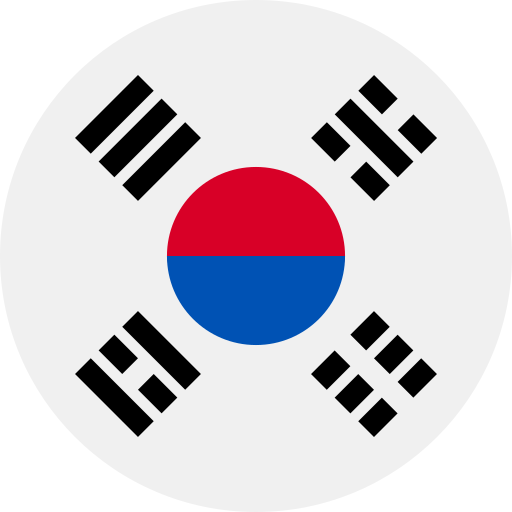
South Korea
Seoul · Asia · Eastern Asia
Population
51.2M
World Bank, 2025
Area
100,210 km²
GDP
$1.88T
World Bank, 2025
GDP Per Capita
$36,238.64
World Bank, 2025
Life Expectancy
83.4 yrs
World Bank, 2025
Capital
Seoul
South Korea is a country located in Eastern Asia, with its capital in Seoul. As of 2025, it has a population of 51.2M and covers an area of 100,210 km². The economy of South Korea has a gross domestic product (GDP) of $1.88T (World Bank, 2025), translating to a per-capita income of $36,238.64 with annual economic growth of 2.0%. Life expectancy in South Korea stands at 83.4 years (World Bank, 2025), among the highest in the world. The official language is Korean, and the currency is the South Korean won (₩). South Korea shares land borders with 1 country.
Population Growth
South Korea, 1994 to 2023
GDP Trend (USD)
Last 15 years
How to Call South Korea
The international calling code for South Korea is +82. When calling from abroad, first dial your country's exit code (for example, 001 in most countries), then 82, then the local number. When dialing internationally, drop the leading trunk prefix "0" from the local number.
Country Code
+82
Exit Code
001
Trunk Prefix
0
Format
+82 10-XXXX-XXXX
Mobile Prefixes
10, 11, 16, 17
Example: To call a number in South Korea from abroad, dial +82 10-5555-5555
How Large Is South Korea's Economy?
South Korea's GDP of $1.88T makes it a high-income economy by World Bank classification. GDP per capita of $36,239 is 224% above the regional average of 11,200 (World Bank, 2025). The economy has grown 29% over the past decade, from $1.43T in 2013 to $1.84T in 2023. The most recent annual growth rate of 2.0% is below the global median of 3.1% (World Bank, 2025). The unemployment rate of 2.7% is 36% below the regional average of 4.2 (World Bank, 2025). Inflation of 2.3% is within the 2-3% range considered stable by most central banks. South Korea's official currency is the South Korean won (₩). As a UN member, South Korea participates in multilateral trade frameworks.
GDP
$1.88T
World Bank, 2025
GDP Per Capita
$36,238.64
World Bank, 2025
GDP Growth
2.0%
Unemployment
2.7%
Inflation
2.3%
Currencies
KRW
GDP Trend (USD)
Last 15 years
What Are South Korea's Demographics?
With 51.2M people, South Korea is among the world's 30 most populous countries. At 511 people per km², the country is densely populated. Population has grown at 0.3% annually over the past decade (World Bank, 2025). Life expectancy stands at 83.4 years, 11.4 years above the global average of 72 years. Infant mortality of 2.3 per 1,000 live births is 87% below the regional average of 18 (World Bank, 2025). The country's official language is Korean. Over the past decade, South Korea's population grew from 44.6M to 51.7M, adding 7.1M people.
Population
51.2M
World Bank, 2025
Life Expectancy
83.4 yrs
World Bank, 2025
Infant Mortality
2.3 per 1k
Literacy Rate
—
Languages
Korean
CO₂ Per Capita
—
Population Growth
South Korea, 1994 to 2023
Where Is South Korea Located?
South Korea covers 100,210 km² (39,000 sq miles) and shares land borders with 1 country. The country sits within the Asia region, Eastern Asia subregion, spanning Asia. Seoul serves as the seat of government and administrative capital of South Korea. The country spans 1 time zone. Recognized internationally by ISO codes KR and KOR, South Korea is an independent sovereign state and a full UN member. Its 1 currency (KRW) reflects its participation in multilateral trade and monetary frameworks.
Area
100,210 km²
Region
Asia
Subregion
Eastern Asia
Capital
Seoul
Timezones
UTC+09:00
Continents
Asia
Border Countries
Data sourced from World Bank Open Data. Last updated: October 2026.
Frequently Asked Questions about South Korea
What is the population of South Korea?
South Korea has a population of 51.2M as of 2025, according to World Bank data. Life expectancy is 83.4 years.
What is the capital of South Korea?
The capital of South Korea is Seoul. It serves as the country's administrative and political center.
What is the GDP of South Korea?
South Korea's GDP is $1.88T as of 2025 (World Bank). GDP per capita is $36,238.64. The economy grew at 2.0% in 2025.
What is the life expectancy in South Korea?
The average life expectancy in South Korea is 83.4 years (World Bank, 2025), among the highest in the world. The infant mortality rate is 2.3 per 1,000 live births.
What region is South Korea in?
South Korea is located in Asia, specifically in Eastern Asia. It is part of the continent of Asia.
What is the size of South Korea?
South Korea covers an area of 100,210 km² (38,691 square miles). The population density is approximately 510.5 people per km².
What currency does South Korea use?
South Korea uses the South Korean won (₩) with currency code KRW.
What language is spoken in South Korea?
The official language of South Korea is Korean.
Is South Korea a member of the United Nations?
Yes, South Korea is a member of the United Nations.
What is South Korea's GDP?
South Korea's GDP is $1.88T (World Bank, 2025). This places it among Asia's economies by total output.
What is South Korea's GDP per capita?
South Korea's GDP per capita is $36,239, which is 224% above the regional average of 11,200 (World Bank, 2025).
What is South Korea's inflation rate?
South Korea's inflation rate is 2.3%, within the 2-3% range considered stable by most central banks (World Bank, 2025).
What is the population density of South Korea?
South Korea has a population density of 511 people per km², making it densely populated.
What is the life expectancy in South Korea?
Life expectancy in South Korea is 83.4 years, 11.4 years above the global average of 72 years (World Bank, 2025).
What is the total area of South Korea?
South Korea has a total land area of 100,210 km² (39,000 sq miles). This measurement covers the country's total sovereign territory as recorded by international geographic databases.
How many countries does South Korea border?
South Korea shares land borders with 1 country (identified by the ISO 3166-1 alpha-3 codes: PRK). These borders define the country's overland connections to the wider region.
What is the calling code for South Korea?
The international calling code for South Korea is +82. To call South Korea from abroad, dial your country's exit code (001), then 82, followed by the local number (drop the leading 0).
How do I call South Korea from the US?
To call South Korea from the United States, dial 011 + 82 + the local phone number (without the leading 0). For example: 011-82-10-5555-5555.
Compare South Korea With...
 India
India China
China United States
 Indonesia
 Pakistan
 Nigeria
 Brazil
 Bangladesh
 Russia
 Mexico
Compare South Korea
Select a country to compare population, GDP, and 12+ indicators side by side.